
27 October 2026
The EU-funded HyInHeat project brought together industry leaders, researchers, technology providers and policymakers for its Final Event, “Switching the Flame: Hydrogen for Energy-Intensive Industry – Steel and Aluminium”, held in Brussels during European Hydrogen Week. The event showcased the project’s main achievements and explored the opportunities and remaining challenges for deploying hydrogen-based heating technologies across Europe’s energy-intensive industries.
As HyInHeat approaches the end of its four-year journey, the event provided an opportunity to reflect on the progress made in demonstrating hydrogen as an alternative to fossil fuels in industrial heating processes, while highlighting the policy and market conditions needed to support its wider adoption.
From Research to Industrial Demonstration
Coordinated by RWTH Aachen University, HyInHeat brings together 28 partners from 12 countries, combining expertise from the steel and aluminium industries, research organisations and technology providers.
Throughout the project, partners have developed, adapted and demonstrated innovative hydrogen-based heating solutions across different stages of steel and aluminium production, including reheating, melting, remelting, ladle preheating and heat treatment.
During the Final Event, industrial partners presented the results of their demonstration activities, highlighting the technical feasibility of replacing natural gas and other conventional fuels with hydrogen in a range of industrial applications.
In the steel sector, demonstrations involving partners such as ArcelorMittal and 7 Steel Nordic provided valuable insights into hydrogen combustion in industrial furnaces and ladle preheating operations. The results confirmed that hydrogen can deliver the high temperatures required for industrial processes, while identifying opportunities to optimise equipment, combustion control and operational performance.
Similarly, aluminium demonstrations involving partners such as METLEN, Befesa, Speira Constellium’s C-TEC and Toyota Motor Europe demonstrated the potential of hydrogen-based heating technologies for melting, recycling and other thermal processes. The findings showed that hydrogen can be integrated into existing industrial equipment while maintaining key performance and product quality requirements.
Beyond technical performance, the project also examined environmental impacts, economic feasibility and operational safety. These assessments provided valuable evidence to support the future deployment of hydrogen technologies across Europe’s energy-intensive industries.
Addressing the Challenges of Hydrogen Deployment
While the demonstrations confirmed hydrogen’s technical potential, the event also highlighted the challenges that must be addressed before these solutions can be widely adopted.
One of the main conclusions was that technical readiness alone is not sufficient to ensure industrial deployment. The high cost of renewable hydrogen, limited supply availability and the need for dedicated infrastructure remain significant barriers for industrial operators.
The project’s environmental and economic assessments also underlined that the climate benefits of hydrogen depend strongly on how it is produced, particularly the availability of low-carbon electricity. At the same time, replacing conventional fuels with renewable hydrogen currently involves substantial operating cost increases in many industrial applications.
Another important topic was the management of nitrogen oxide (NOx) emissions during hydrogen combustion. . A dedicated panel with the European Commission, BREF experts and a furnace supplier showed how rules designed for natural gas can penalise new fuels: the same emissions can read about a third higher on hydrogen because of how they are measured. Participants called for legislation that keeps up with technology, so that it supports the switch rather than slowing it down.
These discussions reinforced the importance of combining technological innovation with reliable energy supply, investment support and an enabling regulatory framework.
From Technological Innovation to Policy Action
The event also provided an opportunity to reflect on the wider policy implications of HyInHeat’s findings.
As highlighted in the project’s Policy Mapping Report, European hydrogen policy is increasingly seeking to balance decarbonisation ambitions with industrial competitiveness. Initiatives such as the Clean Industrial Deal, and the European Hydrogen Bank represent important steps towards supporting hydrogen deployment in energy-intensive sectors.
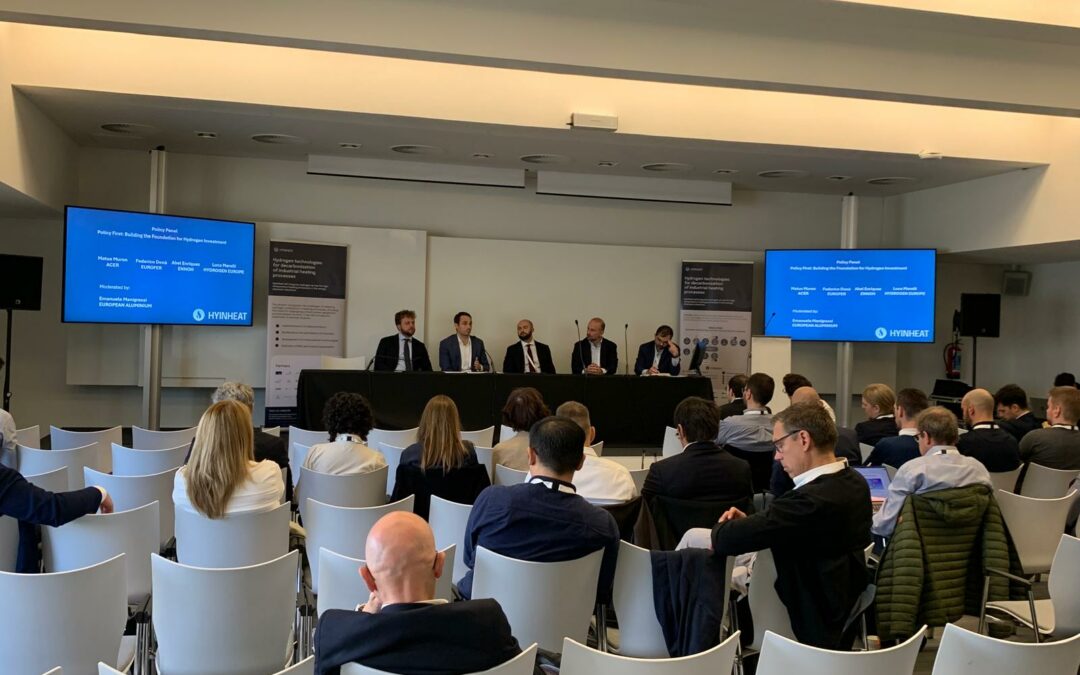
As already emerged from the technical economic assesement, the policy panel, speakers from EUROFER, ACER, ENNOH and Hydrogen Europe stressed that the cost of hydrogen remains far above what steelmakers can afford, and that nearly every electrolytic project so far has relied on public support.
Lowering the final cost of hydrogen will require cheaper energy, simpler production rules and coordinated cross-border corridors with a clear sharing of infrastructure risk. Investors also need stable signals: keeping existing targets and transposing EU legislation quickly. By September 2026, only Italy had fully transposed the Hydrogen and Decarbonised Gas Markets Directive. As one speaker put it, “no rules means no investment”.
The upcoming EU Hydrogen Strategy offers a chance to connect production, infrastructure and demand, prioritise hard-to-abate sectors such as steel and aluminium, and keep the technology basket open.
Looking Ahead: Turning Demonstration Results into Industrial Impact
The Final Event marked an important milestone for HyInHeat, bringing together four years of collaborative research, technological development, and industrial demonstration.
The participation of related European research initiatives, including MaxH2DR and H2AL, also highlighted the value of cooperation and knowledge exchange in accelerating hydrogen innovation across energy-intensive industries. Novelis also presented its plant in Latchford (UK), where it has tested hydrogen at industrial scale in an aluminium recycling furnace, showing how these solutions are already moving from research into real production sites.
As the project enters its final stage, its results provide a valuable foundation for future research, industrial investment and policy discussions.
HyInHeat’s key message is clear: hydrogen-based heating can contribute to the decarbonisation of Europe’s steel and aluminium industries, but its large-scale deployment will require coordinated efforts from industry, policymakers and energy providers.
By connecting technological innovation with practical industrial needs and supportive policy frameworks, Europe can take further steps towards a more sustainable, resilient and competitive industrial future.